Part of our Wisconsin Food Plots guide — dates, seed and soil by season.
The summer mix we planted this year put a great mat down on our sandy plots, but it's built first as deer forage. When the goal is building soil on Wisconsin ground, we would change it. We would keep the cowpeas, cut back the soybeans, sunflower, and buckwheat, swap the grain sorghum for sorghum-sudangrass, and drop the mung beans, LabLab, and Alyce clover. Here's the Central Sands recipe, southern and northern versions, planting dates based on real soil temperatures, and how to crimp it and follow it with a fall plot.
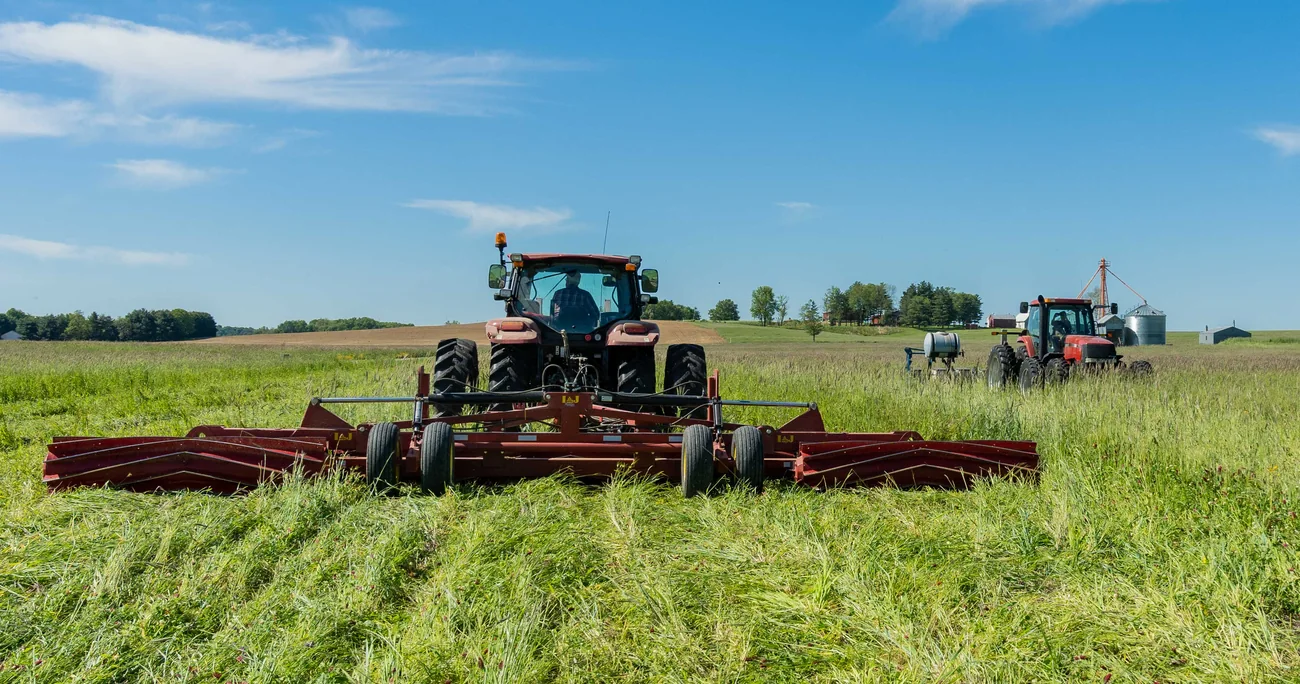
We ran a commercial summer mix on a couple of our sandy plots this year, and it put down a great mat. Then we sprayed it, crimped it, and no-till drilled our fall mix right into it. The research points to drilling before crimping, and the reasons are below. That summer mix is built first as a deer forage blend, though. When the goal is building soil — biomass, deep roots, nitrogen, and a mat that smothers weeds on worn or sandy ground — and the ground is in Wisconsin, we would change a few things. What follows is a Wisconsin Dirt recipe for that job.
If you want a summer plot that feeds deer, use the attraction-focused Central WI Summer Blend in Central Wisconsin Food Plot Blends. This one is about the dirt.
What's in this mix, and why
- Cowpeas carry the mix. NRCS Wisconsin rates cowpea excellent for heat and very good for drought and low fertility, with a preferred pH of 5.5–6.5, which fits acidic sand. SARE puts typical cowpea biomass at 3,000–4,000 lb per acre.
- Soybeans get cut. NRCS says soybeans shouldn't make up more than 20% of a cover mix, and it rates them below cowpea as a soil builder.
- Sorghum-sudangrass replaces grain sorghum. It's the biomass engine (3–5 tons of dry matter per acre in warm conditions, per UW–Madison), it builds more roots after one mowing, and it costs about $1.15 a pound against about $3.05 for food plot grain sorghum.
- Buckwheat and sunflower stay small. Buckwheat covers ground fast and scavenges phosphorus, but its residue doesn't last and it sets seed quickly. Sunflower's taproot is useful, but UW–Madison and the Midwest Cover Crops Council both flag white mold risk.
- Mung beans, LabLab, and Alyce clover go. None of the three is on NRCS Wisconsin's cover crop species table. Cowpea already fills the short-season legume role, and Alyce clover is the priciest seed in the bag at about $5 a pound.
Central Sands DIY recipe
| Species | Lb/acre | Why |
|---|---|---|
| Cowpeas | 15 | The drought-tough nitrogen fixer |
| Sorghum-sudangrass | 10 | Biomass, deep roots, weed suppression |
| Non-GMO soybeans | 8 | More nitrogen, plus some browse |
| Pearl millet | 4 | A second drought-proof grass with long-lasting residue |
| Sunflower | 3 | Taproot for tight subsoil |
| Buckwheat | 3 | Fast first canopy and phosphorus scavenger |
When: June 1–15, once 2-inch soil holds 60°F for several mornings, ahead of a rain. How: no-till drill, with large seeds about ¾–1 inch deep on dry sand and the millet shallower. Broadcast only into an open seedbed with incorporation. Optional: mow once when the sorghum-sudangrass is 3–4 feet tall, leaving 6 inches of stubble. Terminate: late July to early August, then drill your fall plot.
Southern loams and the Northwoods
- Southern loam DIY recipe (44 lb/acre): 10 lb sorghum-sudangrass, 10 lb cowpeas, 5 lb sunn hemp, 8 lb soybeans, 3 lb pearl millet, 3 lb berseem clover, 3 lb buckwheat, and 2 lb sunflower. In Wisconsin trials on silt loam, sunn hemp lost about 1.3% of its yield for every day planting was delayed, so plant around June 5–20, sunn hemp first. Skip the sunflower if the field has a white mold history.
- Northwoods DIY recipe (75 lb/acre): 40 lb spring oats, 30 lb spring forage peas, and 5 lb medium red clover, planted as soon as the ground can be worked in mid-April to mid-May. UW–Madison Extension lists spring oats and peas at 2.5–3 tons of dry matter per acre by late June. Once the oats flower you can drill into them standing and crimp behind the drill, then plant the fall plot in late July or early August. Up north, the soil doesn't hold 60°F until June, and the first frost comes around late September, so a warm-season mix gets very little time.
Plant by soil temperature, not the calendar
We pulled three springs of 9 a.m., 2-inch soil temperatures from UW–Madison's Wisconet stations. Each date is the first day of a five-day run at 60°F or warmer.
| Station | 2024 | 2025 | 2026 | Median last freeze |
|---|---|---|---|---|
| Hancock (Central Sands) | May 18 | May 13 | May 25 | May 10 |
| Arlington (southern silt loam) | June 1 | June 15 | June 4 | May 4 |
| Rhinelander (north) | June 1 | June 17 | June 1 | May 22 |
| Spooner (northwest) | June 12 | June 16 | June 3 | May 14 |
Sand warms fast. Hancock reached a steady 60°F one to three weeks ahead of Arlington, even though Arlington is farther south. Three years is a short record, so buy a soil thermometer and check your own ground.
Crimping and seed-set risk
NRCS Wisconsin says to crimp grasses at flowering or later and legumes at flowering or later, always before seed set, and in the same direction you'll drill. A June planting of buckwheat will drop some seed before a late-July termination. Those volunteers die at the first frost, which is why we keep buckwheat at 3 lb. Cowpeas don't reliably die from rolling alone, and mowed sorghum-sudangrass grows back. So the herbicide does the kill. University of Arkansas trials found a roller alone killed only 40–60% of sorghum-sudan and 0–10% of cowpeas.
The order: spray, drill, then crimp
This year we sprayed, crimped, then drilled. After going through the termination research, the order we recommend is spray, drill, then crimp:
- Spray the standing summer mix on a mild morning while it's actively growing. Glyphosate-type burndowns work about as well before crimping as after (GROW, 2024). Spraying before you seed means you never spray over fall seedlings, which can be up in 3–5 days in August.
- Drill the fall plot into the cover while it's still standing, the same day or within about 3 days. UW–Madison's roller-crimper work plants into standing cover because openers cut standing stems cleanly. Pushing them through a fresh flat mat tucks straw into the slot, so the seed sits in straw instead of dirt.
- Crimp right behind the drill, in the same direction. NRCS Wisconsin notes crimping can work after planting. The mat lands on the rows and holds moisture on the sand.
If the sorghum-sudan is too tall or tangled to drill through, fall back to spray, crimp, then drill in the crimp direction. Follow every herbicide label, including replant intervals for clover, peas, and brassicas. Tillage isn't part of the routine. Save it for fixing a problem, like breaking sod on a first-year plot or working in a big lime correction.
What to plant after
On the Sands, we drill the low-rye, pea-heavy fall blend from Central Wisconsin Food Plot Blends into the mat around August 5–15. On a droughty knob, a rye-based mix holds the sand better. You can also just let the stand freeze and drill in spring. A big sorghum-sudangrass mat is high in carbon, so plan fertilizer for any brassicas from your soil test instead of assuming the cover supplied the nitrogen. More on the system is in no-till food plots in Central Wisconsin.
Get the free guide
The DIY summer soil-building guide is a free 8-page PDF. It covers all three recipes with percent of mix, the full keep, swap, and drop reasoning with sources, the soil temperature and frost data, a termination and seed-set table, a fertility and nitrogen note, and a planting checklist.
Sources
- USDA-NRCS Wisconsin, Cover Crops (340) Guidance Document (NRCS-GD-340 WI, Aug 2025)
- UW–Madison Extension, Full or Late Season Cover Crop Options on Wisconsin Prevented Plant Acres
- UW–Madison IPCM and Midwest Cover Crops Council, Summer Annual Cover Crop Considerations
- Midwest Cover Crops Council, Cover Crop Considerations for Prevented Planting
- UW–Madison Extension, Growing successful late-summer and spring planted forage crops
- Planting Date and Biculture Affect Sunn Hemp Productivity in the Midwest (Wisconsin trials)
- SARE, Managing Cover Crops Profitably
- Wisconet (UW–Madison), soil temperature data
- NOAA 1991–2020 normals, Hancock Exp Farm freeze dates
Quick answers
What is a good summer cover crop for building soil in Wisconsin?
A warm-season mix with a heavy-biomass grass, drought-tough legumes, and a few fast broadleaves. Our Central Sands DIY recipe is 43 lb per acre drilled: 15 lb cowpeas, 10 lb sorghum-sudangrass, 8 lb soybeans, 4 lb pearl millet, 3 lb sunflower, and 3 lb buckwheat. On silt loams in southern Wisconsin, add sunn hemp and berseem clover. In the north, a spring mix of oats, field peas, and red clover fits the short season better.
When should I plant a summer cover crop in Wisconsin?
When the soil at 2 inches is 60°F or warmer at 9 a.m. for several mornings in a row, frost risk has passed, and rain is coming. NRCS Wisconsin opens the window for sorghum-sudangrass, millets, cowpea, sunflower, and sunn hemp on June 1. In UW–Madison's Wisconet data for 2024–2026, Hancock's sandy soil held 60°F starting May 13–25, Arlington's silt loam June 1–15, and Rhinelander June 1–17.
Is sorghum-sudangrass better than grain sorghum for building soil?
For biomass, yes. UW–Madison Extension says sorghum-sudangrass can produce 3–5 tons of dry matter per acre in warm conditions with 60–80 lb of available nitrogen. It's drought tolerant once established and excellent for suppressing weeds and adding organic matter. SARE reports that mowing it once at 3–4 feet can multiply root mass. Cool weather limits it, though, so UW calls it less desirable in northern counties.
When do you crimp a summer cover crop?
NRCS Wisconsin says to roller-crimp grasses at flowering (anthesis) or later and legumes at flowering or later, always before seed set. Crimp in the same direction you'll drill. Buckwheat should be killed within 7 to 10 days after it starts flowering, and SARE notes that rolling or mowing alone doesn't reliably kill cowpeas. So spray first. The research-backed order is spray, then drill the fall plot into the standing cover, then crimp right behind the drill.
Should I just plant a commercial summer premix?
A commercial summer premix can grow well on sandy plots. If you're planting one small plot, a premixed bag is simpler than buying every component. Mixing your own makes the most sense across a few acres, or when building soil matters more than summer forage.
Plan the plot for your Wisconsin county
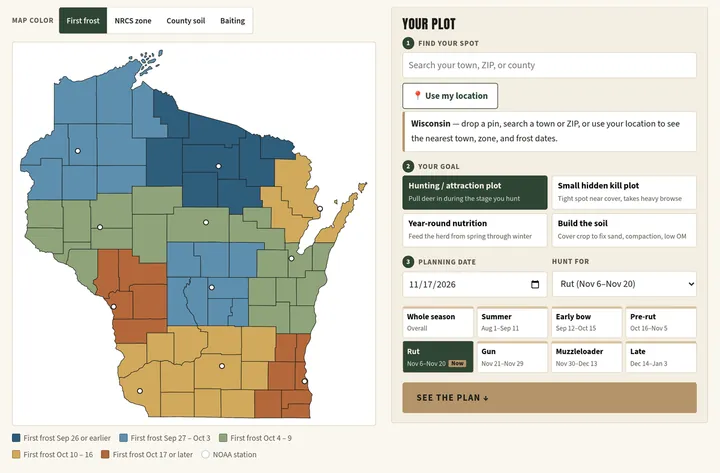
For frost dates and planting windows in your county, open the Wisconsin Food Plot Map or print the free Wisconsin Food Plot Planner. See also Wisconsin food plot planting dates by county, best food plots for Wisconsin deer, and spring food plots in Wisconsin.
General educational information only, not professional, legal, or engineering advice for a specific property. Always follow product labels and check current county and state requirements.