Part of our Wisconsin Food Plots guide — dates, seed and soil by season.
Spring is when Wisconsin food plots are won or lost on paper: a soil test, lime if you need it, a clover or oats plan, and a fall brassica date already on the calendar. Guys start this planning in mid-winter. The goal is to be ready when the ground opens in April and May.
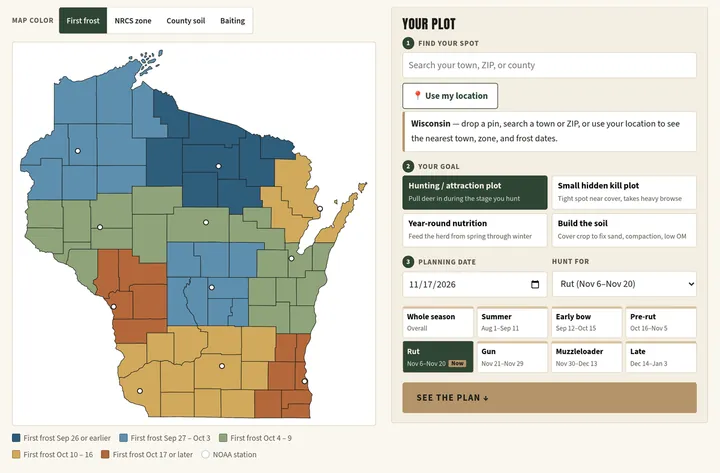
This guide covers spring food plots in Wisconsin — when to plant clover and oats, when frost-seeding makes sense, and when to deal with pH — then points you to the Wisconsin Food Plot Map and the free Wisconsin Food Plot Planner.
When to plant a spring food plot in Wisconsin
Work backwards from your county’s median last spring 32°F frost (May 22 at Rhinelander, May 10 at Hancock in Waushara County, May 1 at Madison, April 23 at La Crosse; NOAA 1991–2020 normals). Cool-season forages do not wait for that date. Oats can germinate at about 38°F (NRCS Wisconsin) and take a light frost, so they often go in as soon as you can work a decent seedbed — mid-April in southern Wisconsin, later as you move north. Warm-season crops (soybeans, cowpeas, sorghum-sudangrass) wait on warm soil, not just the calendar.
When to plant clover in Wisconsin
You have two clover windows:
- Frost-seeding in March. UW Extension says most Wisconsin frost-seeding is done in March, after snow is gone but while the soil is still freezing at night and thawing by day. Medium red clover is the workhorse. This is a renovation method into existing sod or a winter cereal, not the best way to start a brand-new plot from bare sand. Details, rates, and the sandy-soil caveat are in frost-seeding clover in Wisconsin.
- A drilled or broadcast spring seeding. On the Food Plot Map, medium red and white clover windows run about April 15–August 15 in the North zone and April 15–August 25 in the South zone. A spring seeding with a nurse crop of oats is a standard way to start a perennial paddock after you can work the ground. Clover wants pH closer to 6.0–6.8; lime first if the test says so.
Crimson clover is treated as a fall annual here; it is not the first pick for a Wisconsin spring perennial stand.
When to plant oats in Wisconsin
Oats do two different jobs. In spring they are a fast, palatable forage and a nurse crop for clover. In late summer they are part of a fall attraction blend, and they usually winter-kill, leaving a soft mat. For a spring food plot, plant oats when the seedbed is fit, often mid-April in the south. The map’s species window is April 15–September 1 in the North zone and April 15–September 15 in the South zone. Don’t wait until June for a spring oat plot — summer heat and dry sand will work against you. Forage oats and “buck forage oats” follow the same cool-season logic; follow the bag rate and keep seed shallow with firm contact.
Spring soil tests and lime
Fall is the best time to pull a food plot soil test in Wisconsin, because lime can take months to change pH. If you are planning a spring planting and you do not have a current report, test as soon as the ground can be sampled and send it to a lab such as the UW Soil and Forage Lab (our food plot lime guide covers rates and timing), or another accredited lab. Spread lime as the report recommends. You may not get a full pH correction before a May seeding, especially on heavier soils; on sand, lime often reacts faster, but it still is not overnight. The soil testing guide covers how to pull a sample and read pH, phosphorus, and potassium. Wisconsin Dirt does not run a testing lab.
What not to plant in spring if you are hunting in November
A spring brassica plot is not the same as a fall attraction plot. Brassicas planted in spring will bolt and linger past their prime long before gun season. If the goal is November food, plant brassicas in the mid-summer window — late July to early August in the Central Sands. See when to plant brassicas in Wisconsin and the planting dates by county tables.
A simple spring plan
- January–February: fill out the free Wisconsin Food Plot Planner; drop a pin on the Wisconsin Food Plot Map; order seed after you know the soil story.
- March: frost-seed red clover where the soil heaves and residue is short; skip frost-seeding on loose sand.
- April: work or no-till spring oats and clover when the seedbed is fit; keep traffic off wet ground.
- May: finish perennial seedings in the north; watch soil temperature for soybeans and other warm-season crops.
- Keep the fall brassica date on the calendar now, not in July.
Sources
- NOAA National Centers for Environmental Information, U.S. Climate Normals 1991–2020, freeze/frost dates (32°F) at the stations listed
- USDA-NRCS Wisconsin, Cover Crops (340) Guidance Document NRCS-GD-340 WI (08-1-2025): zones, germination temperatures, and planting-date guidance
- UW–Madison Extension, A1525 Table 13: Planting rate and date for forages in Wisconsin
- National Deer Association, When to Plant Fall Food Plots, and What to Do If They Fail
- UW–Madison Extension Crops and Soils, Frost Seeding Legumes and Grasses into Established Pastures (most Wisconsin frost-seeding is done in March)
- UW–Madison Extension Crops and Soils, What Species Work Best for Frost Seeding?
Quick answers
When should I plant a spring food plot in Wisconsin?
Plant cool-season oats and clover as soon as you can make a decent seedbed, often mid-April in southern Wisconsin and later in the north. Frost-seed red clover in March where soils freeze and thaw. Wait for warm soil (about 50°F or more) before soybeans and other summer annuals.
When should I plant clover in Wisconsin?
Frost-seed medium red clover in March, or drill or broadcast a spring seeding from about mid-April into summer (the map’s window is April 15–August 15 in the North zone and April 15–August 25 in the South zone). Correct pH first when a soil test calls for lime.
When should I plant oats for deer in Wisconsin?
For a spring plot, plant oats when the ground can be worked, often mid-April in the south. Oats germinate in cool soil (NRCS minimum about 38°F) and can take a light frost. A second, separate window is late summer, when oats go into a fall attraction blend and usually winter-kill.
Should I lime in the spring?
If a current soil test calls for lime and you missed the fall window, spread it in spring. Lime still needs time to react, so a May clover seeding may not see the full pH change in the first weeks. Fall testing and fall lime are better when you can plan ahead.
Print the plan with the free Wisconsin Food Plot Planner, or drop a pin on the Wisconsin Food Plot Map for frost dates and planting windows in your county.
Need a used food plot drag, disc, cultipacker, no-till drill, or ATV implement? Browse food plot equipment for sale on the Wisconsin Dirt Land Board, or list yours free.
General educational information only, not professional, legal, or engineering advice for a specific property. Always follow product labels and check current county and state requirements. Fertility testing (pH, lime, phosphorus, and potassium) is different from septic soil and site evaluations.