The commercial summer and fall mixes we planted this year grew well on our sandy plots, but Central Wisconsin ground asks for a bag built for this sand, with a known pea and brassica share. Here is the Wisconsin Dirt summer blend and fall blend — the standard bags — and the Central Sands rates and Hancock planting dates.
We've run commercial summer and fall food-plot mixes on our own sandy plots with a spray, crimp, and no-till drill system, and we like what they do for the soil. (The research points to spraying, drilling into the standing cover, and crimping last, as explained below.) We wrote about it in spray, crimp, no-till and no-till food plot results. But Central Wisconsin sand is hard on any seed mix, and commercial fall blends are often rye-heavy. The recipes below are the standard-bag summer and fall blends, with a rate and window card for Central Sands ground.
Why Central Wisconsin needs its own blend
- Sand that won't hold water. UW–Madison Extension puts plant-available water in a loamy sand at about 1.1 inches per foot, versus 2 to 2.5 inches in a silt loam. A dry week on the Central Sands is a dry month somewhere else.
- Low CEC and acidic pH. Sand holds little potassium or sulfur, and it commonly tests below pH 6. Start with a soil test.
- A short season. At the Hancock research station, the median first fall freeze is October 3, and one year in ten it comes by September 20.
- No irrigation. The pivots water the potato fields. Your plot only gets what falls from the sky.
The Central WI Summer Blend (full recipe)
| Species | Lb in bag | % by weight | Why |
|---|---|---|---|
| Cowpeas | 15 | 42.9% | The most drought-tough legume in the mix |
| Soybeans (forage or non-GMO) | 7 | 20.0% | Main summer protein draw, held at 20.0% of the bag by weight to stay inside the WI NRCS 340 cap |
| Buckwheat | 6 | 17.1% | Fastest canopy on poor, acidic sand |
| Forage sorghum | 3 | 8.6% | Deep roots, a trellis for vines, and mat for the crimper |
| Sunflower | 1 | 2.8% | Taproot and browse, kept low so it doesn't shade out the legumes |
| Medium red clover | 3 | 8.6% | A perennial in the summer bag that can carry into later seasons if it establishes |
How this mix is built: we left out mung beans, LabLab, and Alyce clover, which want a longer, hotter season than we get. Soybeans stay at 7 lb (20.0% of the bag by weight) so the mix stays inside the WI NRCS 340 cap at any seeding rate. Cowpeas and buckwheat carry the drought-tough canopy. When: once the soil hits 60°F at 2 inches, best June 1–20 here, ahead of a rain, so the stand can be grown before fall strips go in. Hancock is in the NRCS Wisconsin South zone; the 340 window stays open to August 15. How: no-till drill, ½–¾ inch deep. In late July or early August, spray it, drill the fall blend into it while it's still standing (within about 3 days), then crimp behind the drill in the same direction. A roller alone won't kill sorghum or cowpeas, so the herbicide does the kill. Drilling standing cover gets the seed into dirt instead of a flat straw mat. Follow every herbicide label, including replant intervals.
The Central WI Fall Blend (overview)
The fall blend is the standard bag (72.7 lb): oats, rye, winter peas, red clover, and 2.7 lb of brassicas. On Central Sands, plant it at 88 lb/acre drilled (105 lb/acre broadcast, capped so brassicas stay at or under 4 lb). At that drilled rate, combined brassicas are 3.3 lb.
- Oats 25 lb (34.4%), cereal rye 20 lb (27.5%), and Austrian winter peas 20 lb (27.5%) in the standard bag. Rye holds sand over winter and greens up early. Peas are high-preference, high-protein, and very digestible; 20 lb is a substantial share, not a pure pea stand.
- Medium red clover 5 lb (6.9%). Red clover survives our winters and can flush again in spring.
- Turnip 1.2 lb, Dwarf Essex rape 1.2 lb, and daikon-type radish 0.3 lb, for 2.7 lb of brassicas in the bag, under the WI NRCS 340 cap of 4 lb in a mix even at the broadcast cap.
- Plant brassicas July 26–August 5 at Hancock, 80 to 70 days before the median 28°F hard freeze (October 14). August 5 is the hard stop for brassicas. Oats last day at Hancock is September 4. Peas: the NRCS 340 seeding date opens August 1. Earlier plantings still feed deer but are outside the 340 dates.
If you mostly need soil cover on a droughty knob, a rye-based blend like the one in the best food plot mix for Central Wisconsin sandy soil is still the safer choice.
Competing with the neighbor's fields
You can't out-feed 80 acres of standing corn, so don't try. Win on timing. Soybean leaves drop in September, and alfalfa slows after the hard freezes in mid-October. When the corn comes off, deer go looking for the closest green food near cover. Put the plot against bedding cover, screen it from the road, plan your entry and exit with the wind, and stay out once it's planted. Brassica timing is covered in when to plant brassicas in Wisconsin.
Get the full guide
Central Wisconsin Summer & Fall Blends is a free 10-page PDF. It has the full fall recipe with pounds per acre and percent of mix. It also has a late-planting variant and a dry-knob variant, and planting windows by date. You also get the "out-draw the ag fields" plan, soil-test-first fertility notes, shopping lists scaled from 1 acre to 10,000 sq ft, and a planting checklist.
Sources
- UW–Madison Extension, The important role of soil texture on water
- UW–Madison Extension, Growing great pasture and forage in sandy soils
- UW–Madison Extension, Field Peas
- UW–Madison Extension, Growing successful late-summer and spring planted forage crops
- NOAA 1991–2020 normals, Hancock Exp Farm freeze dates
- National Deer Association, Austrian Winter Peas
- National Deer Association, Do Brassicas Actually Get Sweeter After a Frost?
Quick answers
What is a good summer food plot blend for Central Wisconsin sand?
A warm-season mix built on drought-tolerant legumes and fast canopy plants. The Wisconsin Dirt summer blend standard bag is 35 lb: 15 lb cowpeas, 7 lb soybeans (20.0% by weight, at the WI NRCS 340 cap), 6 lb buckwheat, 3 lb forage sorghum, 1 lb sunflower, and 3 lb medium red clover. On Central Sands, plant it at 38 lb/acre drilled. Plant once the soil reaches 60°F at 2 inches, best June 1–20 in Central Wisconsin so the stand can be grown before fall strips go in. The 340 window on this South-zone ground stays open to August 15.
When should I plant a fall food plot blend in Central Wisconsin?
About July 26–August 5 for brassicas at Hancock, counted 80 to 70 days before the median hard freeze (28°F) of October 14 (1 in 10 as early as September 29; NOAA 1991–2020). Oats and peas can go in through about September 4. Without brassicas, a fall blend of oats, peas, and rye can still go in through early to mid-September.
How much cereal rye is in the fall blend?
The standard fall bag has 20 lb of cereal rye (27.5% by weight), the same share as winter peas. Rye holds sand over winter and greens up early. If your main goal is soil cover on a droughty knob, a rye-based blend is still the safer choice.
Do winter peas survive the winter in Wisconsin?
Usually not reliably. UW–Madison Extension treats field peas as a crop that winter-kills in Wisconsin. Plan on peas feeding deer from emergence through the first hard freezes, and count on red clover and rye to carry the plot into spring.
What order should I spray, crimp, and drill a summer cover before a fall plot?
Spray the standing summer mix first, drill the fall blend into it while it's still standing (within about 3 days), then crimp behind the drill in the same direction. A roller alone kills only 40–60% of sorghum-sudan and 0–10% of cowpeas, so the herbicide does the kill. Spraying before seeding avoids spraying over seedlings, and drilling standing cover gives better seed-to-soil contact than drilling through a flattened mat. Follow every herbicide label.
Do brassicas get sweeter after a frost?
Research from the University of Tennessee, reported by the National Deer Association, found turnip and radish roots were already high in sugar before frost and did not get measurably sweeter afterward. Deer still use brassicas more in cold weather because they are energy-rich food that is still standing when other fields are bare.
Plan the plot for your Wisconsin county
More Wisconsin food plot guides live in the food plots library.
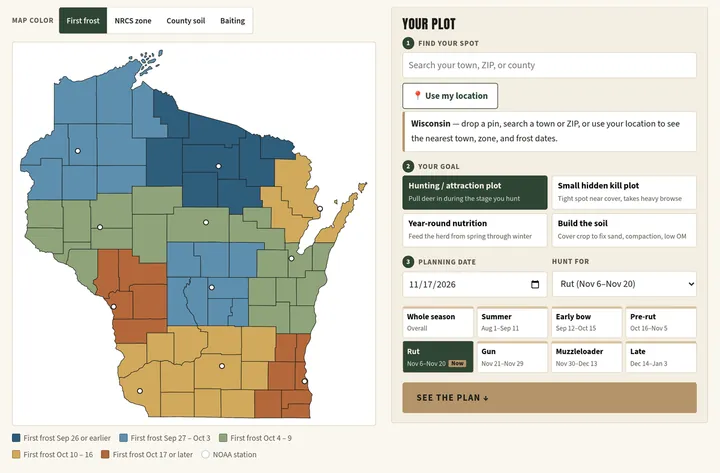
For frost dates and planting windows in your county, open the Wisconsin Food Plot Map or print the free Wisconsin Food Plot Planner. See also Wisconsin food plot planting dates by county, best food plots for Wisconsin deer, and spring food plots in Wisconsin.
General educational information only, not professional, legal, or engineering advice for a specific property. Always follow product labels and check current county and state requirements.