When to plant food plots in Wisconsin depends on your county’s frost dates, not the date on the seed bag. The tables below use NOAA 1991–2020 median 32°F frost dates from 11 weather stations — the same data as the free Wisconsin Food Plot Map — so you can line up spring clover and oats, and a fall brassica window, with the ground you actually hunt.
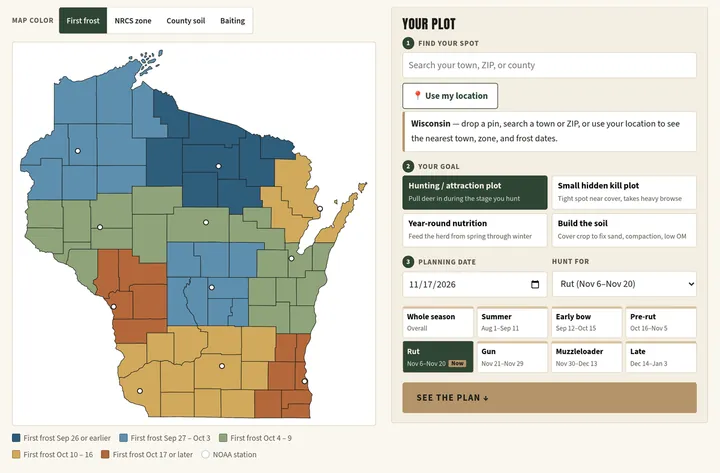
Or type a seed name into the When to Plant tool to get the window, soil temperature, rate, and sources for that crop on your county or ZIP — it uses these same frost dates.
A bag sold for “the North” still has to survive Waushara sand, Oneida frost, or a long Dane County fall. Start with the nearest station, then drop a pin on the Wisconsin Food Plot Map for a plan at your exact county.
How these Wisconsin food plot planting dates work
Fall planting windows below count back from each station’s median hard freeze (28°F) in NOAA’s 1991–2020 climate normals. A hard freeze is 28°F or lower, the point at which most plants are killed (National Weather Service). The 10% date is the year-in-ten case: a 28°F freeze has come that early in 1 year out of 10. Brassicas go in 80 to 70 days before the median hard freeze; 70 days is the hard stop. Oats are best by 60 days before it, with 40 days as the last day (and never past the NRCS 340 oat end date). Summer (warm-season) plantings still use the median 32°F frost as their end-of-season marker. Brassica dates do not run past the NRCS Wisconsin brassica cutoff of August 25 in the North zone and September 1 in the South zone.
These are planning dates, not a guarantee. A frost pocket, a lake-effect shore, or a dry seedbed can move the right day by a week or more. Plant ahead of rain when you can.
Frost dates and fall planting windows by NOAA station
| Station | Region | Last spring frost (median / 10%) | First fall frost, 32°F (median / 10%) | Hard freeze, 28°F (median / 10%) | Frost-free days | Brassica window | Brassica hard stop | Oats last date |
|---|---|---|---|---|---|---|---|---|
| Rhinelander USC00477113 | Far North | May 22 10% still later than Jun 4 | Sep 24 10% earlier than Sep 9 | Oct 4 10% earlier than Sep 20 | 125 | Jul 16–26 | Jul 26 | Aug 25 |
| Spooner Ag Res. Stn. USC00478027 | Northwest | May 14 10% still later than May 29 | Sep 28 10% earlier than Sep 14 | Oct 7 10% earlier than Sep 22 | 137 | Jul 19–29 | Jul 29 | Aug 28 |
| Wausau USW00014897 | North-central | May 6 10% still later than May 21 | Oct 4 10% earlier than Sep 21 | Oct 16 10% earlier than Oct 1 | 151 | Jul 28–Aug 7 | Aug 7 | Sep 6 |
| Eau Claire USW00014991 | West-central | May 8 10% still later than May 21 | Oct 4 10% earlier than Sep 20 | Oct 15 10% earlier than Oct 1 | 149 | Jul 27–Aug 6 | Aug 6 | Sep 5 |
| Hancock Ag Res. Stn. USC00473405 | Central Sands | May 10 10% still later than May 24 | Oct 3 10% earlier than Sep 20 | Oct 14 10% earlier than Sep 29 | 146 | Jul 26–Aug 5 | Aug 5 | Sep 4 |
| Marinette USC00475091 | Northeast | May 4 10% still later than May 20 | Oct 11 10% earlier than Sep 29 | Oct 27 10% earlier than Oct 9 | 160 | Aug 8–18 | Aug 18 | Sep 15 |
| Green Bay USW00014898 | East / Fox Valley | Apr 30 10% still later than May 16 | Oct 9 10% earlier than Sep 24 | Oct 24 10% earlier than Oct 6 | 162 | Aug 5–15 | Aug 15 | Sep 14 |
| Madison USW00014837 | South-central | May 1 10% still later than May 16 | Oct 10 10% earlier than Sep 26 | Oct 22 10% earlier than Oct 6 | 162 | Aug 3–13 | Aug 13 | Sep 12 |
| Lancaster USC00474546 | Southwest | Apr 27 10% still later than May 11 | Oct 11 10% earlier than Sep 27 | Oct 22 10% earlier than Oct 6 | 167 | Aug 3–13 | Aug 13 | Sep 12 |
| La Crosse USW00014920 | Mississippi River | Apr 23 10% still later than May 6 | Oct 17 10% earlier than Oct 3 | Oct 28 10% earlier than Oct 15 | 177 | Aug 9–19 | Aug 19 | Sep 15 |
| Milwaukee USW00014839 | Lake Michigan shore | Apr 19 10% still later than May 2 | Oct 29 10% earlier than Oct 15 | Nov 8 10% earlier than Oct 27 | 193 | Aug 20–30 | Aug 30 | Sep 15 |
When to plant food plots in your Wisconsin county
Each Wisconsin county on the map is assigned to the nearest of those 11 stations. Waushara, Adams, Marquette, Portage, Waupaca, Green Lake, and Wood, for example, all use Hancock Agricultural Research Station in the Central Sands (median last spring frost May 10, first fall frost October 3). Dane County uses Madison; Oneida County uses Rhinelander. Click your county on the map to confirm.
| NOAA station | Region | Counties |
|---|---|---|
| Rhinelander | Far North | Florence, Forest, Iron, Langlade, Lincoln, Oneida, Price, Vilas |
| Spooner Ag Res. Stn. | Northwest | Ashland, Barron, Bayfield, Burnett, Douglas, Polk, Rusk, Sawyer, Washburn |
| Wausau | North-central | Marathon, Menominee, Taylor |
| Eau Claire | West-central | Buffalo, Chippewa, Clark, Dunn, Eau Claire, Pepin, Pierce, St. Croix |
| Hancock Ag Res. Stn. | Central Sands | Adams, Green Lake, Juneau, Marquette, Portage, Waupaca, Waushara, Wood |
| Marinette | Northeast | Door, Marinette, Oconto |
| Green Bay | East / Fox Valley | Brown, Calumet, Fond du Lac, Kewaunee, Manitowoc, Outagamie, Shawano, Sheboygan, Winnebago |
| Madison | South-central | Columbia, Dane, Dodge, Green, Jefferson, Rock, Sauk |
| Lancaster | Southwest | Crawford, Grant, Iowa, Lafayette, Richland |
| La Crosse | Mississippi River | Jackson, La Crosse, Monroe, Trempealeau, Vernon |
| Milwaukee | Lake Michigan shore | Kenosha, Milwaukee, Ozaukee, Racine, Walworth, Washington, Waukesha |
When to plant food plots in Wisconsin: a season calendar
| Season | What to plant | Typical window |
|---|---|---|
| Late winter | Frost-seed medium red clover into existing sod or winter rye, where soils frost-heave | March, after snow melts but while the ground is still freezing and thawing (UW Extension) |
| Early spring | Soil test if you missed fall; lime if the report calls for it; oats and clover once you can work the ground | Mid-April in southern Wisconsin; later in the north. Oats tolerate a light frost (NRCS minimum germination 38°F) |
| Late spring / summer | Soybeans, cowpeas, sorghum-sudangrass screens, buckwheat, soil-building covers | After soil is warm: about 50°F for soybeans, 58°F+ for cowpeas (NRCS WI). Hancock sand often reaches 60°F in mid- to late May |
| Mid- to late summer | Brassicas (turnip, rape, kale, radish) and fall attraction blends | About Jul 26–Aug 5 in the Central Sands (Hancock); mid-to-late July in the far north; later in the south. See the station windows above. Oats and peas can follow after the brassica hard stop |
| Late summer / early fall | Oats, wheat, winter peas; then cereal rye as the cold-hardy fallback | Mid-August into September; rye can go into early October in the north |
For the brassica math in Central Wisconsin, see when to plant brassicas in Wisconsin. For March clover, see frost-seeding clover in Wisconsin and the spring food plot guide.
Central, northern, and southern Wisconsin at a glance
- Northern Wisconsin food plots (Rhinelander, Spooner): last spring frost mid- to late May, first fall frost late September, a 125–137 day frost-free season, and a mid-to-late-July brassica window (Rhinelander Jul 16–26, Spooner Jul 19–29).
- Central Wisconsin food plots (Hancock / Waushara County): last spring frost about May 10, first fall frost about October 3, 146 frost-free days, and a brassica window of about July 26–August 5 (hard stop Aug 5).
- Southern Wisconsin food plots (Madison, Lancaster, La Crosse, Milwaukee): last spring frost mid- to late April, first fall frost mid- to late October, and a later brassica window.
Build a plan for your county
The Wisconsin Food Plot Planner Map turns these dates into a pin on your ground: frost dates, seed rates, and a ranked forage list. The free Wisconsin Food Plot Planner is the printable worksheet for site, soil, seed, timing, and layout. For mixes, see the Central Wisconsin seed blends and the Wisconsin food plots library.
Sources
- NOAA National Centers for Environmental Information, U.S. Climate Normals 1991–2020, freeze/frost dates (32°F) at the stations listed
- USDA-NRCS Wisconsin, Cover Crops (340) Guidance Document NRCS-GD-340 WI (08-1-2025): zones, germination temperatures, and planting-date guidance
- UW–Madison Extension, A1525 Table 13: Planting rate and date for forages in Wisconsin
- National Deer Association, When to Plant Fall Food Plots, and What to Do If They Fail
- Wisconsin Dirt, When to Plant Brassicas in Wisconsin
- UW–Madison Extension Crops and Soils, Frost Seeding Legumes and Grasses into Established Pastures
Quick answers
When should I plant food plots in Wisconsin?
It depends on the crop and your county frost dates. Frost-seed clover in March where soils heave. Plant spring oats and clover once you can work the ground, often mid-April in the south and later in the north. Plant fall brassicas 80 to 70 days before your median 28°F hard freeze — about Jul 26–Aug 5 in the Central Sands at Hancock, mid-to-late July in the far north, and later in the south. Oats and peas can follow after the brassica hard stop.
What is the first frost date for Waushara County?
The nearest NOAA station, Hancock Agricultural Research Station, has a median first 32°F fall frost of October 3 and a median last spring frost of May 10 (1991–2020 normals). One year in ten, fall frost arrives before September 20.
Do I have to memorize dates for every county?
No. Open the free Wisconsin Food Plot Map, drop a pin or tap your county, and you will get the frost dates and planting windows for that pin. The tables on this page are the same underlying NOAA station data.
Are planted food plots legal in a Wisconsin baiting-ban county?
Wisconsin DNR treats standing crops planted as food plots as legal on private land statewide, including in baiting and feeding ban counties. Placing bait, feed, minerals, or salt is a separate rule. Food plots are not allowed on DNR-managed land. Confirm current rules on the DNR baiting map.
Print the plan with the free Wisconsin Food Plot Planner, or drop a pin on the Wisconsin Food Plot Map for frost dates and planting windows in your county.
Need a used food plot drag, disc, cultipacker, no-till drill, or ATV implement? Browse food plot equipment for sale on the Wisconsin Dirt Land Board, or list yours free.
General educational information only, not professional, legal, or engineering advice for a specific property. Always follow product labels and check current county and state requirements. Fertility testing (pH, lime, phosphorus, and potassium) is different from septic soil and site evaluations.