
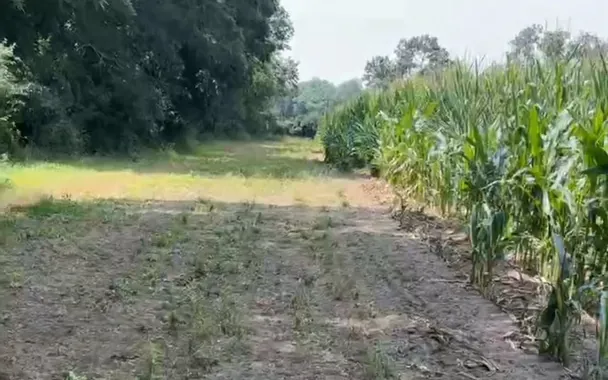
This tool defaults to our own place: Pine River in Waushara County, sandy Central Sands ground, using Hancock Agricultural Research Station for frost and GDD. Change the county or ZIP if you hunt somewhere else. Windows are planning dates, not a guarantee. A frost pocket, a lake-effect shore, or a dry seedbed can move the right day by a week or more.
How we pick the window
We start with the same 11 NOAA 1991–2020 frost stations used on the Wisconsin Food Plot Map and on our planting dates by county tables. Growing degree days are the annual total of NOAA’s monthly growing degree units, base 50°F (and we keep the base 40°F total in the data). Then we apply published agronomy, not a guess:
- Forage soybeans. Eagle Seed: late May or early June in the North, after the last spring frost, when 1-inch soil is above 65°F (62°F in Eagle’s maximum-production FAQ). UW–Madison’s 60°F / mid-May grain-soy calendar is shown as comparison, not as Eagle’s forage date.
- Brassicas. 80 to 70 days before the median 28°F hard freeze (NDA and UW), capped by the NRCS Wisconsin cutoff (August 25 North / September 1 South).
- Winter rye. August through early September (north) or late September (south) for the most biomass (UW). Last strong date: two weeks before the median 28°F freeze (Midwest Cover Crops Council). NRCS 340 still allows later planting, with less fall growth.
- A named variety we don’t have. We fall back to the crop type and say so. We do not invent days to maturity or a rate.
Rates and soil temperatures come from UW–Madison Extension, WI NRCS 340, the Midwest Cover Crops Council, SARE, and the seed company’s own page when we have one. Every result lists those sources.
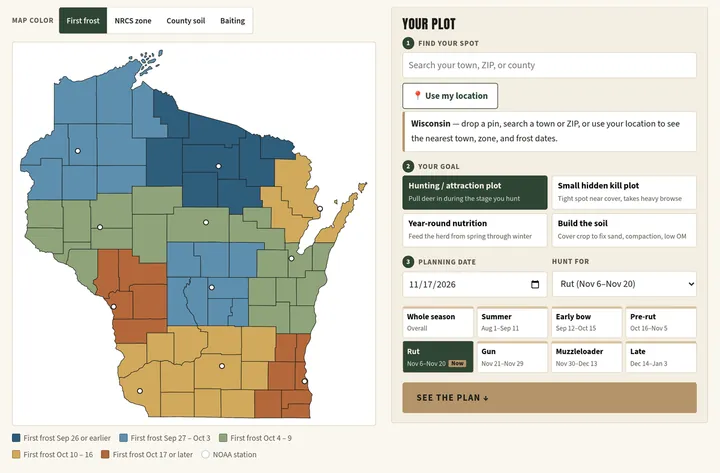 Wisconsin Food Plot Map Drop a pin for frost dates, planting windows, and a plan at your exact property.
Quick answers
When should I plant Eagle forage soybeans on Waushara sand?
Late May to early June, after the last frost and once 1-inch soil is above 65°F (Eagle planting guide). Hancock’s median last spring frost is May 10; 1 year in 10 it has still frozen after May 24. Wisconet readings for 2024–2026 show Hancock sand holding 60°F from mid- to late May. Plant ahead of rain. Eagle does not publish one days-to-maturity number for the forage line; use a North-region mix for Wisconsin.
When should I plant winter rye here?
August through late September for the most biomass in central and southern Wisconsin. At Hancock, two weeks before the median 28°F hard freeze (October 14) is September 30. Most of the tonnage comes in the spring flush. Drill 80–100 lb per acre if you want early-spring forage (UW); 40–60 lb is the usual cover-crop drilled rate (MCCC / UW).
When should I plant a brassica blend in Waushara County?
July 26 to August 5 at Hancock — 80 to 70 days before the October 14 median hard freeze. August 5 is the hard stop. Plant shallow, ahead of rain.
What if my seed isn’t in the list?
Try the crop type (soybeans, rye, brassica, clover, oats). We will say we are using the crop type, not that exact bag. If we have no match, we will tell you rather than invent a date.
General educational information only, not professional advice for a specific property. These are planning windows from published frost normals and agronomy sources, not a forecast and not a promise of yield or tonnage. Always follow the seed tag in your bag, and check current county and state rules before you plant.