Part of our Wisconsin Food Plots guide — dates, seed and soil by season.
Northern Wisconsin food plots have less room for a late start. At Rhinelander the median last spring 32°F frost is May 22 and the first fall frost is September 24 — only about 125 frost-free days (NOAA 1991–2020). Spooner Agricultural Research Station is similar: last spring frost May 14, first fall frost September 28, 137 frost-free days.
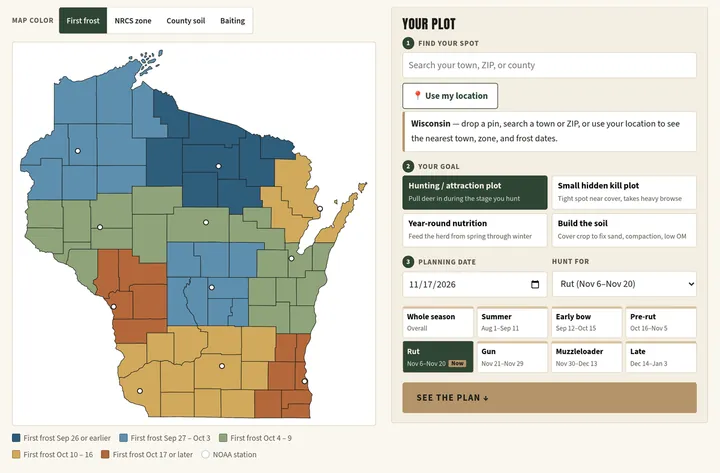
That short season is why “best food plot seed for northern Wisconsin” almost always means cool-season, early-planted species, and why the brassica window on the Wisconsin Food Plot Map is July 16–26 at Rhinelander (hard stop July 26) and July 19–29 at Spooner (hard stop July 29).
What those frost dates mean
The 10% dates matter up here. At Rhinelander, one year in ten the last spring frost arrives after June 4, and one year in ten the first fall frost arrives before September 9. Plan the main fall plot for early August, not late August. If you miss it, switch to cereal grains rather than forcing a full brassica stand.
Best food plots for northern Wisconsin deer
- Spring: oats and medium red clover once the ground can be worked, often late April into May. Frost-seeding clover still belongs in March where soils heave — see frost-seeding clover in Wisconsin.
- Fall: oats, winter peas, and brassicas (turnip, rape, kale, radish) in that early-August window. Cereal rye is the reliable late fallback into September and early October.
- Summer annuals: soybeans, cowpeas, and sorghum have a tight window. They need warm soil and still have to finish before a late-September frost. Use them with your eyes open, or keep the acre in cool-season forages.
For a side-by-side with the rest of the state, use Wisconsin food plot planting dates by county and best food plots for Wisconsin deer.
pH, drainage, and short summers
Northern plots still need a soil test. Cold, wet, or acidic soils will stall clover and alfalfa no matter how early you plant. Lime in fall when you can. Pull a sample with the soil testing guide, then write the year down in the free Wisconsin Food Plot Planner.
Sources
- NOAA National Centers for Environmental Information, U.S. Climate Normals 1991–2020, freeze/frost dates (32°F) at the stations listed
- USDA-NRCS Wisconsin, Cover Crops (340) Guidance Document NRCS-GD-340 WI (08-1-2025): zones, germination temperatures, and planting-date guidance
- UW–Madison Extension, A1525 Table 13: Planting rate and date for forages in Wisconsin
- National Deer Association, When to Plant Fall Food Plots, and What to Do If They Fail
Quick answers
When should I plant fall food plots in northern Wisconsin?
Plan on mid-to-late July for brassicas. At Rhinelander the map’s brassica window is July 16–26 (hard stop July 26). At Spooner it is July 19–29 (hard stop July 29). Those windows count back from each station’s median 28°F hard freeze (Rhinelander Oct 4, 1 in 10 as early as Sep 20; Spooner Oct 7, 1 in 10 as early as Sep 22). Oats can go in through about Aug 25 at Rhinelander and Aug 28 at Spooner.
When should I plant clover or oats in northern Wisconsin?
Frost-seed red clover in March where soils heave. Plant spring oats and drilled clover once you can work the ground, later than in southern Wisconsin — often late April into May, with Rhinelander’s median last spring frost on May 22.
What is the best food plot seed for northern Wisconsin?
Short-season, cold-tolerant species: oats, winter peas, brassicas, cereal rye, and medium red clover. Treat heat-loving summer annuals as a tighter, riskier window.
Print the plan with the free Wisconsin Food Plot Planner, or drop a pin on the Wisconsin Food Plot Map for frost dates and planting windows in your county.
Need a used food plot drag, disc, cultipacker, no-till drill, or ATV implement? Browse food plot equipment for sale on the Wisconsin Dirt Land Board, or list yours free.
General educational information only, not professional, legal, or engineering advice for a specific property. Always follow product labels and check current county and state requirements. Fertility testing (pH, lime, phosphorus, and potassium) is different from septic soil and site evaluations.