Part of our Wisconsin Food Plots guide — dates, seed and soil by season.
Southern Wisconsin gives food plots a longer runway than the north, but the right date still depends on which station you are nearest. Madison’s median last spring 32°F frost is May 1 and the first fall frost is October 10 (162 frost-free days). Lancaster is April 27 and October 11 (167 days). La Crosse, on the Mississippi, is April 23 and October 17 (177 days). Milwaukee’s lakeshore is later still (NOAA 1991–2020 normals).
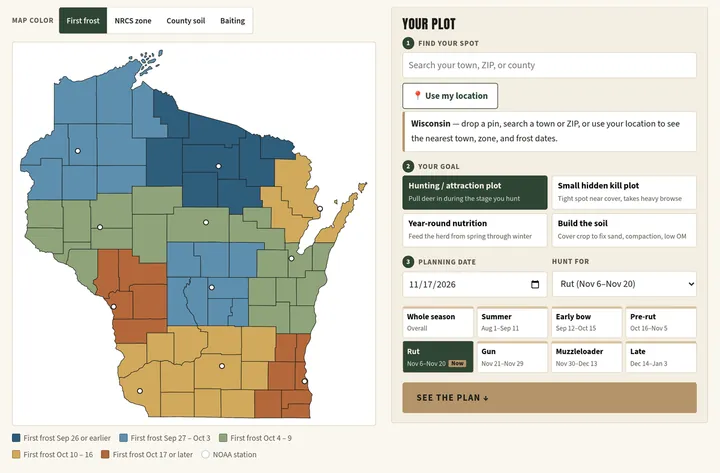
On the Wisconsin Food Plot Map, those hard-freeze dates produce a later brassica window than Central or Northern Wisconsin: about August 3–13 at Madison and Lancaster (hard stop August 13), and August 9–19 at La Crosse (hard stop August 19). Milwaukee’s lakeshore brassica window is August 20–30 (plant the first half; the full bag closes Aug 25 with red clover). Oats can go later, through about September 12 at Madison and Lancaster and September 15 at La Crosse and Milwaukee. Do not use a Milwaukee date for a valley frost pocket inland — drop a pin on your actual ground.
What to plant in southern Wisconsin
- Spring: oats and clover can go in earlier than in the north, often mid-April, because the seedbed is fit sooner and oats take a light frost. Frost-seed red clover in March on heaving soils. See spring food plots in Wisconsin.
- Summer: soybeans and other warm-season crops have a more realistic season here if soil temperature and drainage cooperate. Alfalfa is more plausible on well-drained ground with pH near 6.8–7 than it is on Central Sands.
- Fall: brassicas, peas, and cereals in the later August windows above. You still should not plant brassicas in late September and expect a full stand.
Heavier silt loams and clays in the south hold water and nutrients better than Plainfield sand, but they also crust, stay wet, and can trap equipment in April. Wait for a fit seedbed. No-till or planting into cover is one way to protect structure; the principles in no-till food plots still apply.
Don’t borrow a northern bag date
A mix written for the far north can be planted too early or too light for a southern Wisconsin fall. Use planting dates by county and best food plots for Wisconsin deer, then print your layout with the free Wisconsin Food Plot Planner.
Sources
- NOAA National Centers for Environmental Information, U.S. Climate Normals 1991–2020, freeze/frost dates (32°F) at the stations listed
- USDA-NRCS Wisconsin, Cover Crops (340) Guidance Document NRCS-GD-340 WI (08-1-2025): zones, germination temperatures, and planting-date guidance
- UW–Madison Extension, A1525 Table 13: Planting rate and date for forages in Wisconsin
- National Deer Association, When to Plant Fall Food Plots, and What to Do If They Fail
Quick answers
When should I plant food plots in southern Wisconsin?
Spring oats and clover often go in mid-April once the seedbed is fit. Fall brassicas run later than in the north — about August 3–13 around Madison and Lancaster (hard stop Aug 13), and August 9–19 at La Crosse (hard stop Aug 19), counted from each station's median 28°F hard freeze. Confirm with the station table or the free map.
Can I grow alfalfa as a food plot in southern Wisconsin?
More often than on Central Sands, yes — if drainage is good and pH is near 6.8–7. Alfalfa is still a demanding crop. Start with a soil test, and don’t frost-seed alfalfa as your main establishment method.
Is the Milwaukee frost date right for my inland plot?
Not necessarily. Lake Michigan delays frost on the shore. Inland valleys can freeze earlier. Use the nearest station as a start, then drop a pin on the Wisconsin Food Plot Map and watch your own microclimate.
Print the plan with the free Wisconsin Food Plot Planner, or drop a pin on the Wisconsin Food Plot Map for frost dates and planting windows in your county.
Need a used food plot drag, disc, cultipacker, no-till drill, or ATV implement? Browse food plot equipment for sale on the Wisconsin Dirt Land Board, or list yours free.
General educational information only, not professional, legal, or engineering advice for a specific property. Always follow product labels and check current county and state requirements. Fertility testing (pH, lime, phosphorus, and potassium) is different from septic soil and site evaluations.