Part of our Wisconsin Food Plots guide — dates, seed and soil by season.
Frost-seeding clover is one of the cheapest spring jobs on a Wisconsin food plot or pasture: broadcast red clover onto bare, frozen ground in March and let freeze-thaw work the seed in. It is also easy to get wrong. UW Extension research and on-farm experience say it works best in heaving soils, not on loose Central Sands, and it is a renovation tool, not a way to start a brand-new plot.
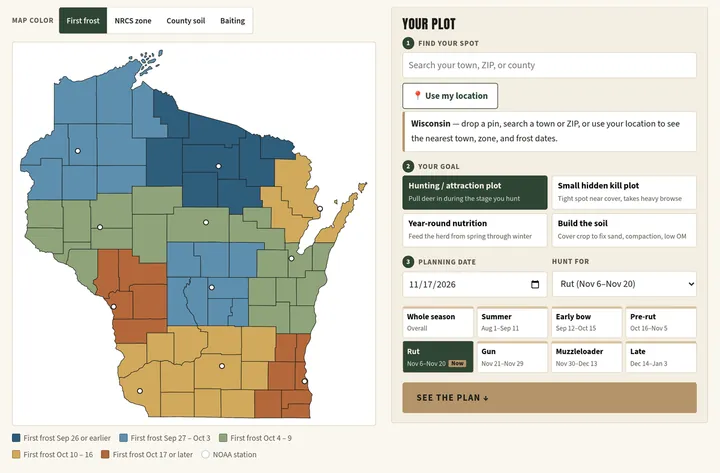
If you are planning spring food plots in Wisconsin, read this before you walk out with a hand seeder, then put the rest of the year on the free Wisconsin Food Plot Planner and the Wisconsin Food Plot Map.
When to frost-seed clover in Wisconsin
UW–Madison Extension writes that most frost-seeding in Wisconsin is accomplished during March: after the snow is gone, but while the ground is still frozen and the surface is cracking through nightly freezes and daytime thaws. Seeding earlier than March increases loss to birds and rodents. Seeding on top of deep snow is a risk, because a fast melt can wash seed away. A light skiff is sometimes tolerated; a packed drift is not.
That March window arrives a little earlier in southern Wisconsin and later in the far north, but the cue is the soil, not the county line: freeze by night, thaw by day, snow mostly gone, soil still firm.
What species and rate to use
UW Extension and Wisconsin on-farm experience point to medium red clover as the most reliable legume for frost-seeding. Birdsfoot trefoil also has a good record. Alfalfa, white or ladino clover, and alsike clover have been used with mixed results; one UW forage article recommends against frost-seeding alfalfa because it germinates poorly in very cold soil. For a hunting plot, red clover is the default.
From UW Crops and Soils guidance on species and rates (pounds per acre):
| Species | Seeded alone | In a mixture |
|---|---|---|
| Red clover | 4–8 | 3–4 |
| Birdsfoot trefoil | 4–6 | 2–3 |
| Ladino clover | 2–3 | 1–2 |
| Alsike clover | 2–4 | 1–2 |
Use pre-inoculated seed, or inoculate it, and calibrate a hand or ATV broadcaster so you are not dumping the whole bag on the first pass.
How to give the seed a chance
- Remove residue in the fall so seed can reach soil. UW notes that a short sod or a winter cereal is a better seedbed than a thatch mat.
- Broadcast onto the frozen surface during the freeze-thaw period.
- Keep competition down after germination. In a pasture that means timely grazing or clipping; on a food plot, don’t let last year’s weeds close the canopy over new clover.
- Expect less uniformity than a drill. UW forage specialists have long said frost-seeding is acceptable for improving a stand, not for establishing a new hay field from scratch.
Skip frost-seeding on sandy Central Wisconsin soils
This matters for Waushara, Adams, and other Central Sands ground. A UW Extension forage publication states that frost-seeding is not recommended for sandy soils because freezing and thawing does not incorporate the seed. On Plainfield sand and similar soils, drill or otherwise place clover in the regular spring window (from about mid-April, once the seedbed is fit) and fix pH first. See the sandy-soil mix guide and food plots in Central Wisconsin.
pH still comes first
Clover is not a shortcut around a sour plot. If a soil test calls for lime, spread it and give it time. Fall lime is better than a March panic spread, but a spring application is still worth doing if you are behind. The soil testing guide, the food plot lime & soil pH guide and the spring food plot guide cover timing.
Sources
- UW–Madison Extension Crops and Soils, Frost Seeding Legumes and Grasses into Established Pastures
- UW–Madison Extension Crops and Soils, What Species Work Best for Frost Seeding? (includes rates)
- UW–Madison Extension Team Forage, Frost Seeding of Forages
- UW–Madison Extension, Frost Seeding of Forages (PDF; notes frost-seeding is not recommended on sandy soils)
- NOAA National Centers for Environmental Information, U.S. Climate Normals 1991–2020, freeze/frost dates (32°F) at the stations listed
- USDA-NRCS Wisconsin, Cover Crops (340) Guidance Document NRCS-GD-340 WI (08-1-2025): zones, germination temperatures, and planting-date guidance
Quick answers
When should I frost-seed clover in Wisconsin?
Plan on March, after snow has melted but while the soil is still freezing at night and thawing during the day, which is the window UW Extension describes for most of Wisconsin. Let the freeze-thaw cycle, not a calendar date alone, tell you when to broadcast.
What clover is best for frost-seeding?
Medium red clover is the most reliable choice in Wisconsin research and on-farm experience. Birdsfoot trefoil also works. Alfalfa is a weaker frost-seed candidate. Use about 4–8 pounds per acre of red clover alone, or 3–4 pounds in a mixture, per UW Crops and Soils.
Can I frost-seed clover on sandy soil in Waushara County?
Usually no. UW Extension advises against frost-seeding on sandy soils because freeze-thaw does not pull the seed in. On Central Sands ground, drill clover in the regular spring planting window and correct pH if a soil test calls for lime.
Is frost-seeding enough to start a new Wisconsin food plot?
Treat it as a way to add clover to an existing sod or winter cereal, not as the only step on bare ground. For a new plot, use the free Wisconsin Food Plot Planner and a drilled or well-cultipacked spring seeding.
Print the plan with the free Wisconsin Food Plot Planner, or drop a pin on the Wisconsin Food Plot Map for frost dates and planting windows in your county.
Need a used food plot drag, disc, cultipacker, no-till drill, or ATV implement? Browse food plot equipment for sale on the Wisconsin Dirt Land Board, or list yours free.
General educational information only, not professional, legal, or engineering advice for a specific property. Always follow product labels and check current county and state requirements. Fertility testing (pH, lime, phosphorus, and potassium) is different from septic soil and site evaluations.