Part of our Wisconsin Food Plots guide. Dates, seed and soil by season.
Low pH holds back more Wisconsin food plots than seed or fertilizer does. Here's how to work out how much lime your plot needs, what pH each food plot crop wants, and when to spread it, using the same UW-Madison formulas that Wisconsin soil labs use.
Quick answer: how much lime per acre?
It depends on your soil pH and buffer pH, so start with a soil test. Under UW-Madison Extension guidelines (A2809):
- No lime if your soil pH is within 0.2 of the target pH for your crop.
- Most soils: at least 2 tons/acre of 60–69 lime (or 1.5 tons/acre of 80–89 lime) when lime is needed.
- Sands and loamy sands under 1% organic matter: 1 ton/acre when the formula comes out under 1.5 tons.
- Never more than 12 tons/acre in one application.
An independent lab soil test confirms exact lime and fertilizer needs. Wisconsin Dirt doesn't test soil. We give you the math and the guidance.
What pH do food plot crops need?
UW guidelines lime to the target pH of the most acid-sensitive crop you plan to grow in the next four years, not just this season's crop. If clover is anywhere in your rotation, lime for clover.
| Crop | Target pH |
|---|---|
| Alfalfa | 6.8 |
| Medium red clover, white (ladino) clover | 6.3 |
| Soybeans | 6.3 |
| Turnips, sugar beets | 6.3 |
| Kale, rape, radish (other brassicas) | 6.0 |
| Winter wheat, corn | 6.0 |
| Oats | 5.8 |
| Cereal (winter) rye | 5.6 |
Targets as used in the Wisconsin Food Plot Map, drawn from UW-Madison Extension (A2809) crop pH targets. Organic and muck soils have lower UW targets, so follow your lab on those.
How labs work out the lime rate
Soil pH tells you whether the ground is acidic. Buffer pH tells the lab how much acidity is held in reserve, which is what sets the tonnage. Two plots at pH 5.5 can need very different amounts of lime. UW uses one formula per target pH (A2809, Table 5.1), in tons per acre of 60–69 grade lime:
| Target pH | Lime (tons/acre of 60–69 lime) |
|---|---|
| 5.6 | 51.0 − (5.40 × buffer pH) − (2.67 × soil pH) |
| 6.0 | 72.7 − (7.59 × buffer pH) − (3.78 × soil pH) |
| 6.3 | 103 − (12.6 × buffer pH) − (3.18 × soil pH) |
| 6.8 | 195 − (28.4 × buffer pH) + (0.144 × soil pH) |
Worked example. A clover plot (target 6.3) tests at soil pH 5.5 and buffer pH 6.5. That's 103 − 81.9 − 17.5 = 3.6, which rounds to 4 tons/acre of 60–69 lime. With 80–89 lime that's 4 × 65 ÷ 85 = 3.1, rounded to 3 tons/acre. The lime calculator runs every target pH in the table, plus UW's minimum-rate, deep-tillage and no-till rules.
How much lime for a 1/2 acre or 1/4 acre food plot?
Most Wisconsin food plots are under an acre, so convert the per-acre rate before you buy. One ton per acre is 2,000 lb per acre, or about 46 lb per 1,000 sq ft.
| Rate on your report | 1 acre | 1/2 acre | 1/4 acre | Per 1,000 sq ft |
|---|---|---|---|---|
| 1 ton/acre | 2,000 lb | 1,000 lb | 500 lb (10 × 50-lb bags) | 46 lb |
| 2 tons/acre | 4,000 lb | 2,000 lb | 1,000 lb (20 bags) | 92 lb |
| 3 tons/acre | 6,000 lb | 3,000 lb | 1,500 lb (30 bags) | 138 lb |
| 4 tons/acre | 8,000 lb | 4,000 lb | 2,000 lb (40 bags) | 184 lb |
Don't know your acreage? Draw the plot on the aerial map and the acres fill into the calculators.
60–69, 80–89 and pelletized lime
Lime is graded by its neutralizing index (NI), which combines how pure it is and how finely it's ground. Most Wisconsin soil reports list the rate for both 60–69 and 80–89 grade lime. For anything else, UW's conversion is:
Tons of your lime = tons of 60–69 lime recommended × (65 ÷ your lime's NI), using the midpoint of a range (80–89 = 85).
- Compare cost per acre after adjusting for NI, not cost per ton. A higher-grade lime can be the cheaper way to do the job, and hauling is a big part of the cost, so local quarries are often the best buy.
- Pelletized lime is finely ground limestone pressed into pellets so it runs through a broadcast spreader. It corrects acidity according to its neutralizing value, like any other lime. A few bags can't stand in for a report that calls for tons, so use the NI on the bag in the calculator.
- Finer lime reacts faster. UW suggests paying for finer material when you're liming no-till ground or seeding an acid-sensitive crop right after liming.
When to lime, and how long it takes
- Lime is slow. Expect months, not weeks. Fall is the best time to spread for next year's plot. Spring lime still beats none, but don't expect the full change before a May clover seeding.
- No-till plots: UW recommends 1 ton/acre topdressed (60–69 or 80–89 lime) on ground no-tilled for more than 5 years when the top 2 inches is more than 0.2 below target, then a retest in 3 to 4 years.
- Tilling deeper than 7 inches mixes lime into more soil, so the rate goes up: ×1.15 for 7–8 in., ×1.31 for 8–9 in., ×1.46 past 9 in. (A2809, Table 5.2).
- Limed in the last 2 years? UW says to wait 2 to 3 years for the last application to react and retest before adding more, even if you haven't reached the target.
- Big pH jump needed? Consider delaying acid-sensitive crops like clover or alfalfa a year. Plant something that tolerates acidic ground, like cereal rye, oats or buckwheat, while the lime works.
Sandy ground in central Wisconsin
Sands and loamy sands, like much of the Central Sands, aren't as well buffered as loams and silts. A smaller rate moves the pH, but it drifts back sooner. UW notes sandy soils may need lime more often, at much lower rates, and caps low-organic-matter sands at 1 ton/acre when the formula comes out low. Retest these plots every couple of years. More on that ground: best food plot mix for central Wisconsin sandy soil.
When pH is already high
If your soil pH is at or above the target, don't lime. Many soils in southeastern Wisconsin are naturally alkaline (UW). Lowering pH takes elemental sulfur and many months, so on a food plot it usually makes more sense to pick crops that handle the pH you have. Ask your lab before trying it.
How to lime a Wisconsin food plot, step by step
- Pull a soil sample from the plot and send it to an independent lab (for example the UW Soil & Forage Lab). Our guide shows how to pull a sample.
- Find soil pH, buffer pH and the lime requirement on the report.
- Pick the target pH for the most acid-sensitive crop you'll grow in the next four years (clover: 6.3; alfalfa: 6.8).
- Convert for your lime's NI and your plot's acreage. The free calculator does both.
- Spread it early, ideally in fall, and work it in if you till. On long-term no-till, topdress at the UW rate.
- Retest in 2 to 4 years before adding more. Log the date and rate in the free plot journal.
Plan the rest of the plot
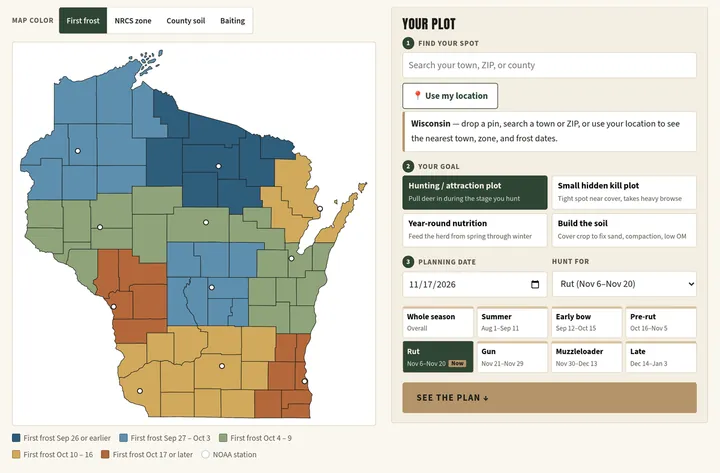
Once pH is on track, use the Wisconsin Food Plot Map for planting windows at your pin, the USDA soil type, and a rotation note based on what you planted last year. See also soil testing your food plot, frost-seeding clover in Wisconsin, when to plant brassicas in Wisconsin, and planting dates by county.
Quick answers
How much lime does a 1/2 acre food plot need?
Take the per-acre rate from your soil test and halve it. At 2 tons per acre, a half-acre plot needs 2,000 lb (about 40 fifty-pound bags). UW-Madison guidelines rarely call for less than 2 tons per acre of 60–69 lime (1.5 tons of 80–89 lime) on most soils once lime is needed, or 1 ton per acre on low-organic-matter sands.
How much pelletized lime do I need for a food plot?
Use the rate on your soil test and adjust it for the pelletized lime's neutralizing index printed on the bag: tons of 60–69 lime recommended × (65 ÷ the product's NI). Pelletized lime corrects acidity according to its neutralizing value like any other lime, so a few bags can't stand in for a report that calls for tons per acre.
How long does lime take to work in a food plot?
Months, not weeks. Spread it in fall for next year's plot when you can. UW-Madison Extension advises waiting 2 to 3 years after an application and retesting before adding more.
What soil pH does a clover food plot need?
UW targets 6.3 for red and white clover and 6.8 for alfalfa. Brassicas like kale, rape and radish and grains like wheat target about 6.0, oats 5.8 and cereal rye 5.6. Lime for the most acid-sensitive crop you'll grow in the next four years.
Can I lime a food plot without a soil test?
You can, but it's a guess. The lime rate depends on buffer pH, which only a lab test measures. An independent lab soil test confirms exact lime and fertilizer needs, and a test usually costs less than a bag of seed.
Does Wisconsin Dirt test soil?
No. Send samples to an independent lab such as the UW Soil & Forage Lab. Wisconsin Dirt's free calculator does the math on the lab's numbers and converts them to your plot size.
Sources
- UW-Madison Extension, A2809 Nutrient Application Guidelines for Field, Vegetable, and Fruit Crops in Wisconsin: Soil pH and Lime Requirement (Tables 5.1 and 5.2, minimum and maximum rates, NI conversion, choosing a liming material). Checked Nov 23, 2026.
- UW Soil & Forage Lab.
- USDA-NRCS Wisconsin, Cover Crops (340) Guidance Document NRCS-GD-340 WI (crop pH tolerance).
General educational information, not a soil-lab recommendation for your property. An independent lab soil test confirms exact lime and fertilizer needs. Follow product labels.