Part of our Wisconsin Food Plots guide — dates, seed and soil by season.
If you are planting food plots in Waushara County — around Wautoma, Wild Rose, Redgranite, Pine River, or Poy Sippi — plan off Hancock Agricultural Research Station. The NOAA 1991–2020 median last spring 32°F frost is May 10, the median first fall frost is October 3, and the frost-free stretch is about 146 days.
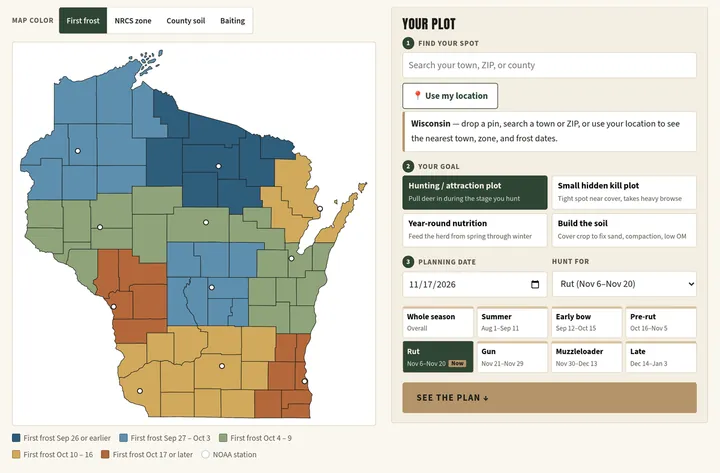
Wisconsin Dirt is based in this county, and the Wisconsin Food Plot Map uses those Hancock dates for Waushara ground. The map’s brassica window here is about July 26–August 5 (hard stop August 5). Oats and peas can go in through about September 4. That is the same math as the when to plant brassicas in Wisconsin guide.
What grows on Waushara sand
A lot of this county is Central Sands: droughty, low organic matter, and often acidic. The food plot mix that holds up is winter rye and oats first, brassicas in moderation, and clover only after pH is corrected. Read the best food plot mix for Central Wisconsin sandy soil and food plots in Central Wisconsin.
Do not count on frost-seeding clover on loose sand. UW Extension does not recommend frost-seeding on sandy soils, because freeze-thaw will not pull the seed in. Drill clover in the spring window instead, and lime on the soil-test recommendation.
A Waushara County planting snapshot
| Job | Typical timing |
|---|---|
| Last spring 32°F frost (median / 10%) | May 10 / May 24 |
| First fall 32°F frost (median / 10%) | October 3 / September 20 |
| Spring oats and drilled clover | When the seedbed is fit, often mid- to late April |
| Soil near 60°F (Hancock observations on the map) | Often mid- to late May |
| Fall attraction / brassicas | Brassicas about July 26–August 5 (hard stop Aug 5); oats and peas through about September 4 |
| Cereal rye fallback | September into early October |
More Waushara County resources
For hunting land context, see the Waushara County land guide and the town pages for Wautoma, Wild Rose, Redgranite, Pine River, and Poy Sippi. For the plot itself, print the free Wisconsin Food Plot Planner and drop a pin on the Wisconsin Food Plot Map.
Sources
- NOAA National Centers for Environmental Information, U.S. Climate Normals 1991–2020, freeze/frost dates (32°F) at the stations listed
- USDA-NRCS Wisconsin, Cover Crops (340) Guidance Document NRCS-GD-340 WI (08-1-2025): zones, germination temperatures, and planting-date guidance
- UW–Madison Extension, A1525 Table 13: Planting rate and date for forages in Wisconsin
- National Deer Association, When to Plant Fall Food Plots, and What to Do If They Fail
- Wisconsin Dirt, When to Plant Brassicas in Wisconsin (Central Wisconsin Dates)
- Wisconsin Dirt, Waushara County hunting land guide
Quick answers
When should I plant food plots in Waushara County?
Plant spring oats and clover when the seedbed is fit, often mid- to late April. Plant brassicas about July 26–August 5 (hard stop Aug 5), counted from Hancock’s median hard freeze (28°F) of October 14 (1 in 10 as early as Sep 29). Oats and peas can go in through about September 4. Use cereal rye if you miss that window.
What is the first frost date in Wautoma or Waushara County?
At Hancock Agricultural Research Station, the median first 32°F fall frost is October 3 (1 in 10 as early as September 20). The median hard freeze (28°F) is October 14 (1 in 10 as early as September 29). The median last spring frost is May 10.
What should I plant on Waushara County sand?
A cereal-grain base of winter rye and oats, a modest brassica share, and clover only where pH is corrected. Skip frost-seeding clover on loose sand; drill it in spring instead.
Print the plan with the free Wisconsin Food Plot Planner, or drop a pin on the Wisconsin Food Plot Map for frost dates and planting windows in your county.
Need a used food plot drag, disc, cultipacker, no-till drill, or ATV implement? Browse food plot equipment for sale on the Wisconsin Dirt Land Board, or list yours free.
General educational information only, not professional, legal, or engineering advice for a specific property. Always follow product labels and check current county and state requirements. Fertility testing (pH, lime, phosphorus, and potassium) is different from septic soil and site evaluations.