Wisconsin's nine-day gun deer season opens Saturday, November 21, 2026, and runs through Sunday, November 29. This page is a Central Wisconsin logistics guide for GameReg registration, CWD sampling, and carcass or baiting rules in Waushara, Waupaca, Marquette, Adams, Portage, and Green Lake counties. Sources were checked November 13, 2026.
This is not legal advice, and it is not a substitute for the current regulations. Confirm the DNR deer hunting page, the deer season dates and bag limits, and the pages linked below before you hunt, register a deer, submit a CWD sample, or move a carcass. Locations and bans can change during the season.
For the full 2026 date chart, including muzzleloader, antlerless, and holiday hunts, see 2026 Wisconsin gun deer season dates and rules. County baiting status and a longer CWD discussion are on CWD zones and baiting rules by county in Wisconsin. If you are hunting someone else's ground, put permission in writing; start with Wisconsin hunting lease agreement basics.
2026 opener dates
Three current DNR sources, all checked November 13, 2026, give the same nine-day window. There is no date mismatch among them:
- A November 10, 2026, DNR news release says the 2026 gun deer season opens Saturday, November 21, and runs through Sunday, November 29.
- The DNR deer season dates and bag limits page lists Gun Deer as November 21–29, statewide, with all legal weapon types allowed. Metro subunit dates are November 21–December 9.
- The DNR season dates and application deadlines page lists the same Gun dates: November 21–29, and Gun in metro subunits only as November 21–December 9.
The six Central Wisconsin counties this page covers are not discussed on those pages as metro subunits. If you hunt elsewhere, confirm your unit on the official regulations or the 2026 deer season structure map. Muzzleloader season begins November 30, the day after the nine-day hunt closes.
Register the deer (GameReg)
All harvested deer must be registered electronically. The deadline, repeated on the DNR deer registration page, the deer hunting page, and the November 10 opener release, is 5 p.m. the day after the deer is recovered.
The DNR lists four ways to register:
- Online through Go Wild at gowild.wi.gov. Log in with your username and password. The GameReg page and the November 10 opener release call this the fastest and easiest method. The opener release also notes that you do not need to know the tag or authorization number if you register this way. After you log in, use Manage Your GameReg and your current tags or harvest authorizations.
- Online through GameReg at gamereg.wi.gov. Enter your unique harvest authorization or tag number to start. The DNR deer registration page also lists this online option as a fastest-and-easiest method.
- By phone, 24 hours: 1-844-426-3734 (1-844-GAME-REG). When prompted, use the keypad to spell the first three letters of the county. The DNR's example: for Adams County, enter A-D-A by pressing “232.” A list of county codes (PDF) is linked from the GameReg page.
- In person: at a deer registration location that provides a phone or computer to the public. Find those stations in the DNR's searchable registration, CWD sampling, and disposal database, or search “registration stations” on the DNR website.
Have your harvest authorization number ready if you use GameReg or the phone line. After a successful registration you receive a 10-character confirmation number. For white-tailed deer, all confirmation numbers begin with “W” and are issued in the format W12-345-6789 (the DNR's example pattern, not a real confirmation). You no longer need to write that number on the tag or harvest authorization, but keep it. A taxidermist or meat processor may ask for it, and you can look it up later under Harvest History in your Go Wild account. Registration is a separate step from CWD sampling; do both if you are submitting a sample.
CWD sampling and drop-off locations
CWD testing through the DNR is free for deer harvested in Wisconsin and is available statewide. It is not required. Hunters who harvest a deer in a 2026 priority area are encouraged to submit a sample. The November 10 opener release and a September 22, 2026, herd-health release both say the DNR is especially interested in samples from priority areas, and the herd-health release also encouraged more samples from central and northern Wisconsin.
The official DNR CWD Sampling Needs – 2026 map is dated October 29, 2026. For the six counties this page covers, that map lists:
- Priority (additional sampling needed near recent wild and/or captive CWD positives): Waushara, Waupaca, and Green Lake.
- Higher recent positivity (greater than 5% of deer tested from 2024–2025 were CWD positive; sampling still available by hunter request): Adams and Marquette.
- Hunter request: Portage.
This page does not invent kiosk or drop-off addresses. The DNR does not publish a fixed county-by-county street list on a static page. It says locations on the landscape change throughout the season, and that many self-service kiosks are added ahead of the nine-day gun deer season. Before you leave with a head or a carcass, check one of these official tools and look again if your hunt runs more than a day:
- Sampling for chronic wasting disease (CWD), which embeds the current location map.
- The full-page CWD sample and disposal locations map.
- The searchable database of CWD sampling, registration, and deer-disposal sites. You can filter by county and by location type, including self-service kiosks, staffed sampling, appointment-only sampling, dumpsters, landfills, transfer stations, and electronic-registration sites.
The DNR offers four ways to submit a sample:
- Self-service kiosks, open 24/7. Drop off the deer's head with 5 inches of neck attached. If you are using a self-service kiosk, you will be advised to remove the antlers before placing the head in the dropbox.
- In person with a cooperating meat processor, taxidermist, or other business that assists with sampling.
- At-home lymph node extraction. Pick up a packet with sample bags and a unique sample barcode at a CWD kiosk, follow the DNR's extraction instructions, and return the samples to a kiosk.
- By appointment with local DNR staff. Contact the Wildlife Switchboard at DNRWildlifeSwitchboard@wisconsin.gov or 608-267-0866. Leave the county you are in, preferred dates and times, and your contact information.
Register the deer in GameReg first. That is a separate process from the CWD form. The DNR recommends using the online CWD form, which can auto-fill your name, phone number, customer ID, harvest authorization number, and registration confirmation number; the form is also linked from the harvest-registration confirmation email. Paper forms are available at sampling locations.
Take the deer to a sampling station as soon as possible. If you do not bring the full carcass, remove the head with 5 inches of neck attached. Heads can be brought to a sampling location up to five days after harvest if kept refrigerated at 35°F to 45°F, or longer if frozen. You may skull-cap a buck after registration and before sampling if you want to keep only the antlers. The DNR also says a deer head with about 5 inches of neck may be taken to an approved sampling site in a different county from the harvest county, and that heads are disposed of properly after tissue removal.
On the sampling-page FAQ, results in an average year are available 10–14 days after the deer is brought to a station. A September 22, 2026, DNR release said results are typically available within two weeks, and the DNR's fall hunting forecasts noted that 2026 budget constraints could slightly increase turnaround time. Recheck the DNR sampling or results pages for current timing. The Wisconsin Department of Health Services and the Centers for Disease Control and Prevention recommend against eating venison from a deer that tests positive for CWD.
If a hunter receives a CWD-positive result, the September 22 release says a replacement harvest authorization is issued to the Go Wild account within 2–4 days of notification. A positive from an antlered authorization is replaced with an antlered authorization valid statewide; a positive from an antlerless registration is replaced with an either-sex authorization for the same deer management unit and land type. Those replacement authorizations are not weapon-specific and, per that release, remain valid for the rest of the current season and the next year's seasons, starting in September 2027. Confirm the current rule on the DNR site if you receive a positive result.
Carcass movement and disposal
As of the DNR carcass movement, processing and disposal page checked November 13, 2026, the department recommends not transporting whole deer carcasses to areas outside the county or adjacent county where the animal was harvested. That is the language on the current carcass page. This article does not treat that recommendation as a ban. Recheck the carcass page, and the deer carcass transportation regulations page, before you move an animal.
The DNR's preferred disposal path is a landfill, because a landfill is built to keep potentially infectious material out of the environment. Not every landfill or transfer station accepts deer carcass waste. Current options, listed by the DNR in order of effectiveness and practicality, are:
- A landfill, transfer station, municipal curbside pickup if your local solid-waste provider allows it, or a deer carcass waste dumpster. Find sites on the same CWD sample and disposal locations map.
- Bury the waste on your land, or on private land with the landowner's permission, deep enough that scavengers cannot dig it up.
- Return the waste to the location of harvest, again on your land or private land with permission. It is illegal to dispose of carcass waste on public land, a roadway, or private property without permission. Field dressing a deer and leaving the gut pile and associated parts on-site on public or private land is still permitted.
A September 22, 2026, DNR release said 2026 budget pressure will leave dumpsters available statewide but at fewer locations than in prior years, and it asked hunters to have a backup plan. Check acceptance rules with your landfill, transfer station, or hauler before you go.
Hunters may quarter a deer to get it out of the field. Before registration, only one quartered deer may be stored or transported at a time, but a quartered deer may be transported with other intact deer. Non-edible parts may be left in the field after quartering.
Whole carcasses and certain parts from states or provinces where CWD has been found in wild cervids are not allowed into Wisconsin unless taken to a licensed meat processor or permitted taxidermist within 72 hours of entry. Out-of-state hunters should also check their home state's rules for deer harvested in a CWD-affected area in Wisconsin before they head home.
Baiting and feeding in these counties
Deer baiting and feeding are prohibited in all six of these counties as of the DNR baiting and feeding regulations page, whose map is dated November 9, 2026. That page lists 13 counties where baiting and feeding are still allowed, none of them Waushara, Waupaca, Marquette, Adams, Portage, or Green Lake, and 59 counties where they are prohibited. Washburn County's ban was lifted on November 9, 2026; the DNR said no additional counties were scheduled to have a ban removed during the rest of the 2026 deer seasons. New detections can still add or extend bans this year, including during gun week, so check that page again before you hunt or place anything on the ground.
County-level detail, including how a ban renews after a new wild or captive positive, is on the CWD zones and baiting rules page. Recheck the DNR map rather than relying on last year's memory or a year-to-date zero in your county.
Sources
- Wisconsin DNR news release, Wisconsin's 2026 Nine-Day Gun Deer Season Opens Nov. 21 (November 10, 2026)
- Wisconsin DNR, Deer Season Dates and Bag Limits
- Wisconsin DNR, Season dates and application deadlines
- Wisconsin DNR, Deer hunting
- Wisconsin DNR, Registration (deer)
- Wisconsin DNR, GameReg — electronic game registration
- Wisconsin DNR, GameReg (register a deer)
- Wisconsin DNR, Go Wild
- Wisconsin DNR, GameReg county codes (PDF)
- Wisconsin DNR, Sampling for chronic wasting disease (CWD)
- Wisconsin DNR, DNR CWD Sampling Needs – 2026 (PDF, October 29, 2026)
- Wisconsin DNR, CWD sample and disposal locations map
- Wisconsin DNR, Find CWD sampling, registration, and deer disposal sites
- Wisconsin DNR, Chronic wasting disease (CWD)
- Wisconsin DNR, Carcass movement, processing and disposal
- Wisconsin DNR, Deer carcass transportation regulations
- Wisconsin DNR, Baiting and feeding regulations (map dated November 9, 2026)
- Wisconsin DNR news release, DNR Shares Deer Herd Health Reminders And Updates (September 22, 2026)
- Wisconsin DNR, Fall Hunting Forecasts
- Wisconsin DNR, 2026 Deer Management Units and Season Structure map
Quick answers
When does Wisconsin's 2026 nine-day gun deer season open and close?
It opens Saturday, November 21, 2026, and runs through Sunday, November 29, 2026, statewide. A November 10, 2026, DNR news release, the DNR deer season-dates page, and the DNR season-dates list all give the same window. In metro subunits, the gun deer season runs November 21 through December 9, 2026. Confirm your unit on the official regulations or season-structure map if you hunt outside Central Wisconsin.
When do I have to register a deer, and how does GameReg work?
Register the deer electronically through GameReg by 5 p.m. the day after the carcass is recovered. You can register online through Go Wild (gowild.wi.gov) by logging in, online at gamereg.wi.gov with your harvest authorization number, by phone 24 hours at 1-844-426-3734 (1-844-GAME-REG), or in person at a station that provides a public phone or computer. Keep the 10-character confirmation number; for white-tailed deer it begins with W and follows the DNR example pattern W12-345-6789.
Where are CWD kiosks or drop-off locations in Waushara, Waupaca, Marquette, Adams, Portage, and Green Lake counties?
The DNR does not publish a fixed county-by-county address list on a static page. Locations are added throughout the season, with many added ahead of the nine-day gun deer hunt, and they can change. Use the DNR CWD sampling page, the CWD sample and disposal locations map, or the searchable station database, and check again before you drive. Testing through the DNR is free for deer harvested in Wisconsin.
Is CWD testing required, and which of those counties are 2026 sampling priorities?
CWD testing through the DNR is not required. It is free and available statewide, and hunters who harvest a deer in a 2026 priority area are encouraged to submit a sample. On the DNR CWD Sampling Needs map dated October 29, 2026, Waushara, Waupaca, and Green Lake are Priority; Adams and Marquette are in the higher-recent-positivity group (more than 5 percent of deer tested in 2024–2025 were CWD positive), with sampling still available by hunter request; and Portage is in the hunter-request group.
Can I move a whole deer carcass out of the county where I harvested it?
As of the DNR carcass page checked November 13, 2026, the department recommends not transporting whole deer carcasses outside the county of harvest or an adjoining county. That is a recommendation, not quoted here as a ban. Recheck the DNR carcass page before you move an animal. The DNR says a deer head with about 5 inches of neck may be taken to an approved sampling site in another county. Whole carcasses and certain parts from states or provinces with CWD in wild cervids may not enter Wisconsin unless taken to a licensed meat processor or permitted taxidermist within 72 hours of entry.
Is baiting or feeding deer legal in Waushara, Waupaca, Marquette, Adams, Portage, or Green Lake County during the 2026 gun season?
Not as of the DNR baiting-and-feeding map dated November 9, 2026. All six counties were among the 59 Wisconsin counties where deer baiting and feeding are prohibited. New CWD detections can add or extend bans during the season, so recheck the DNR baiting page before you hunt or place anything on the ground.
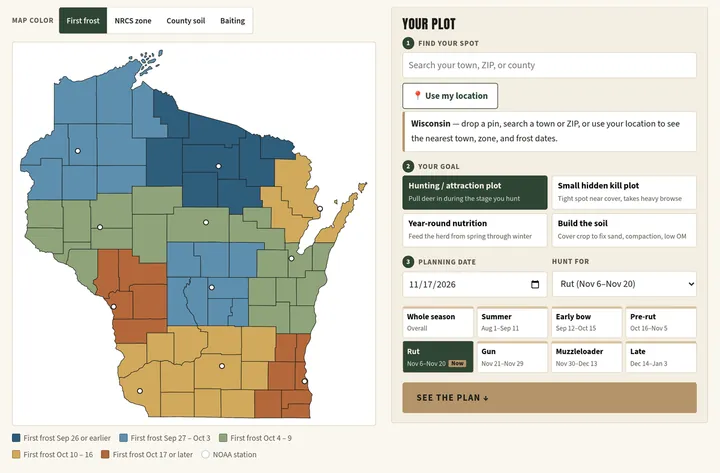
After the deer are registered and the stands come down, put next year’s plots on paper. The free Wisconsin Food Plot Planner walks you through site, soil, seed, and timing before spring.
General educational information only, not professional, legal, or engineering advice for a specific property. Always follow product labels and check current county and state requirements.